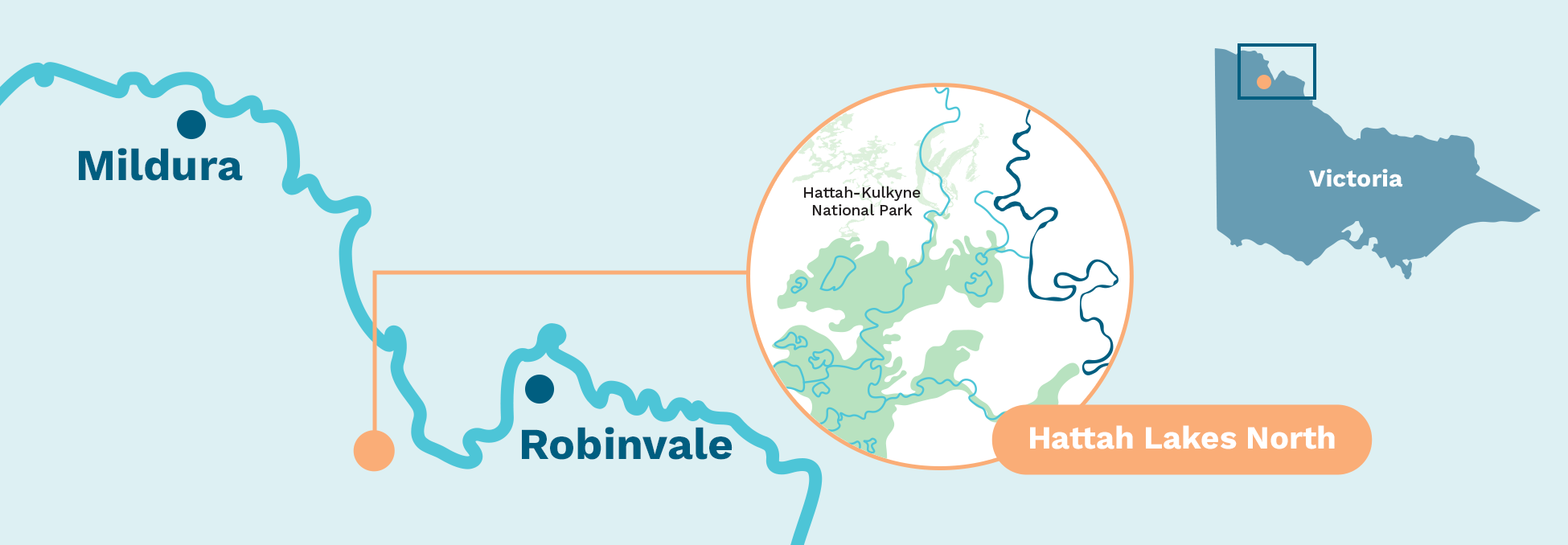
Hattah Project Site
The Hattah Lakes are one of the Murray River’s most iconic floodplain systems.
Project Information
I want to…

Information
The Hattah Lakes North project is in the final stage of a long-term program to restore the internationally significant floodplains of Hattah-Kulkyne National Park.
Work will soon begin on the western bank of the Murray River between Robinvale and Red Cliffs, to connect the northern and southern lakes, allowing water to be delivered across the floodplains in a controlled and carefully timed way.
Previous works at the southern lakes under The Living Murray Program have improved ecological health and supported environmental and cultural outcomes. Works at the northern lakes will complete the project’s original vision.
Environmental watering will help regenerate native trees, grasses and understorey plants, stabilise sandy soils, and restore habitat for wildlife that depends on inundation to survive. The park contains Ramsar-listed wetlands that provide important habitat and breeding grounds for more than 47 species of waterbirds.
Hattah-Kulkyne National Park is a special place and holds deep cultural, spiritual and historical significance for Traditional Owners. Protecting cultural heritage is a key consideration in the project’s design and delivery.
Returning water to the floodplain and stabilising soils helps prevent erosion and protect culturally sensitive sites, including burial places that can be exposed as lakes dry and sands shift.
The project will help ensure Hattah’s floodplains remain healthy, resilient, and protected for future generations.
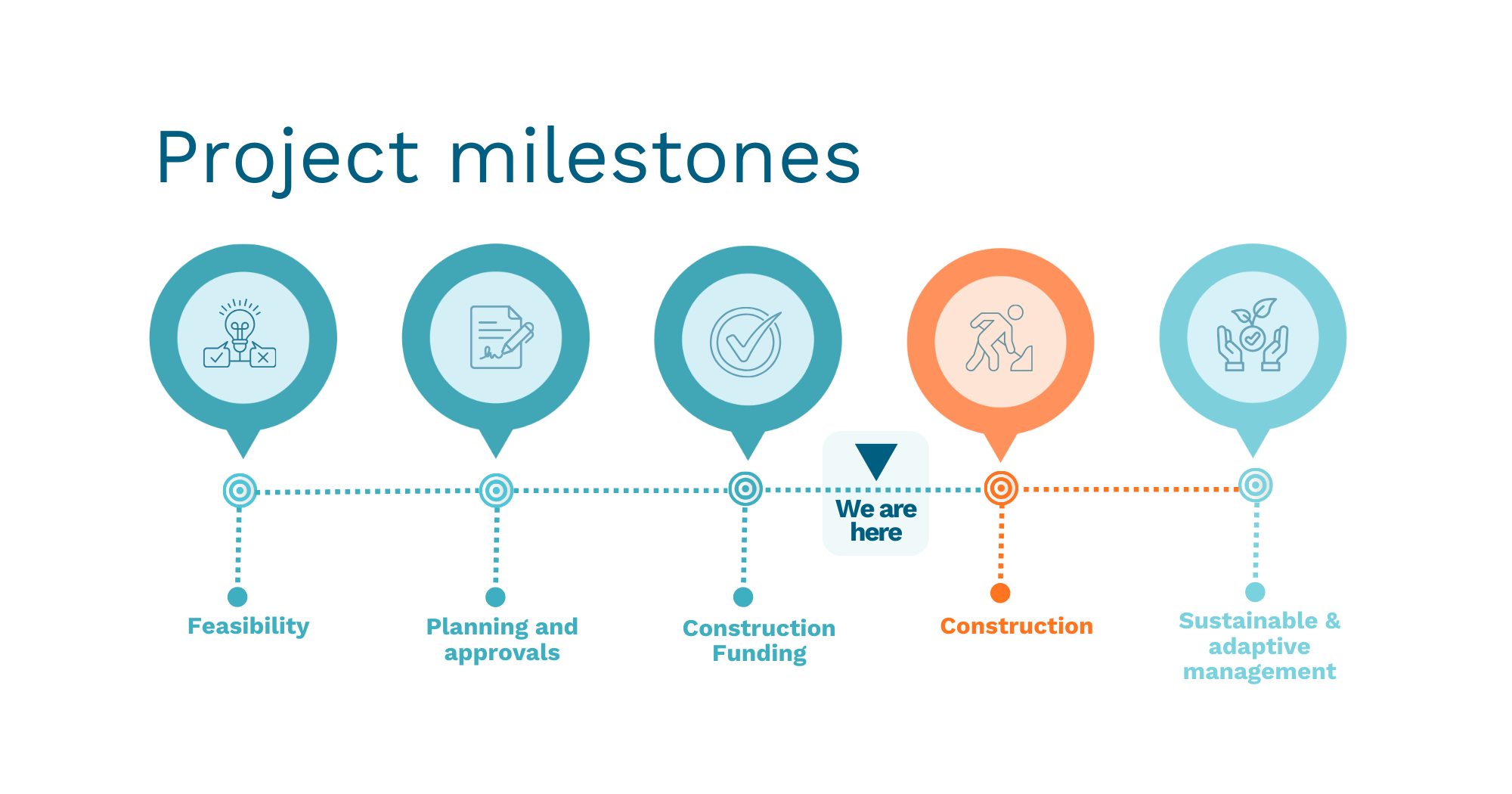
Project phase: Pre-construction
Fast Facts
1,237 hectares
Of lakes and floodplain targeted for improved ecological health.
57 threatened species
Threatened animal species.
20,000 waterbirds
Recorded during flooding.
Cultural significance
Aboriginal cultural significance acknowledged and respected.
Local employment
Opportunities during construction.
Healthy landscapes
Supporting healthy landscapes and community wellbeing.
Project Milestones
Works update
Preliminary site investigations and assessments are currently taking place and construction works are scheduled to begin from mid-April, after the Easter break, until December 2026.
Visitors are advised to check the Parks Victoria website for the latest access information: www.parks.vic.gov.au
Park access
No access changes will occur until the construction phase begins, after the Easter break. The following access changes will occur once construction commences:
- The vast majority of popular camping areas and river frontage will remain open while works are taking place. Some remote river frontage will be temporarily closed, and these areas will be clearly signed.
- Mournpall Track will remain open, however temporary speed limits and traffic controls may apply.
- River Track will be closed to vehicles and pedestrians at Goosefoot Track to allow works to be carried out safely.
- There will be limited access via the River Track’s southern entry.
This map shows indicative access changes during the construction phase. Visitors are advised to check the Parks Victoria website for the latest access information: www.parks.vic.gov.au
What is happening at Hattah Lakes North?
Raised containment banks and gated structures known as regulators will be constructed as part of the managed water system being delivered at Hattah through the VMFRP. Visitors are asked to take care when travelling through the area and to follow all signage and directions.
Download our Preparing for Works Factsheet for more information
Works near Mournpall Track
Mournpall Track will remain open as works take place adjacent to the track. Construction works will include:
- Raised containment banks
- A five-bay gated structure (regulator) to the north
- A three-bay gated structure (regulator) at Bitterang to the south
Works near River Track
River Track will be closed from mid-April until December 2026 to allow works to be carried out safely. Construction works will include:
- Raised containment banks
- Two three-bay gated structures (regulators) at different locations along the track.
What to expect during construction
- Increased traffic and heavy vehicle movements on local roads
- Temporary changes to access
- Construction activity during working hours
- Temporary fencing and signage
News and media
Coming soon.
Frequently Asked Questions
Why are floodplain restoration works required at Hattah Lakes?
Over time, the Murray River has been regulated with weirs, dams and levees to support communities, agriculture and industry. While this has delivered many benefits, it has reduced the frequency, duration and extent of natural flooding required to keep landscapes healthy.
At the northern Hattah Lakes, flooding now occurs far less often, with some areas going more than 20 years between floods, which is too long for floodplain plants and animals to survive.
Previous works in the southern lakes under The Living Murray program have shown that carefully designed infrastructure can successfully reconnect the river to its floodplains and restore ecological health. The new works will extend watering to more of the floodplain and allow water to be delivered when natural floods do not occur. This will help keep the floodplain healthy and resilient.
What happens if the floodplains are not restored?
The Murray River and its floodplains are part of an interconnected ecosystem that depends on natural wet and dry cycles to stay healthy and keep the river rich with nutrients.
Reduced flooding has increased stress on floodplain vegetation, weakened tree canopies and reduced habitat and food for wildlife. Without intervention, these iconic Australian landscapes will continue to decline, placing biodiversity, cultural values and regional communities at risk. If we do not intervene, these landscapes may decline beyond the point of rejuvenation.
What is happening at Hattah?
Containment banks will be constructed alongside existing tracks to hold water onto the floodplain during inundation. Four gated structures, known as regulators, will also be built along existing tracks to manage flows.
Why was Hattah chosen?
The Hattah Lakes are Ramsar-listed and provide important habitat and breeding sites for more than 47 waterbird species. More than 20,000 waterbirds have been sighted when the lakes are flooded.
Hattah-Kulkyne National Park is a place of cultural significance for Traditional Owners. It is also a much-loved recreational place for campers, bushwalkers, bike riders, and boating enthusiasts. The VMFRP is also supporting the ongoing health and resilience of the floodplain.
How are the Hattah Lakes being protected from construction impacts?
Protecting the national park is a priority. Construction is guided by approved environmental and cultural heritage management plans, with guidelines in place to protect vegetation, wildlife, water quality and culturally significant areas. Works are carefully planned and monitored in collaboration with project delivery partners and Traditional Owners to minimise impacts during construction. Where possible, construction will take place on existing access tracks and areas that have already been disturbed.
Plans have been developed through an extensive environmental assessment process that has satisfied both the Australian and Victorian Governments that the project will achieve its ecological, social and cultural objectives while minimising environmental impacts during construction and beyond.
Long-term monitoring of ecological, cultural and social outcomes will be undertaken before, during and after flood events to ensure the intended benefits are realised. Where outcomes do not align with expectations, management approaches will be adapted over time, including adjustments to future watering plans, to ensure the project’s objectives are achieved.
Will trees be removed as part of the works?
To support the long-term health of the floodplain and enable works to be carried out safely and effectively, a limited number of trees will be removed within the defined construction footprint. Tree removal has been carefully assessed through the project’s environmental approvals process, and the footprint has been refined to minimise impacts wherever possible.
Removed timber will be repurposed wherever feasible, including for fish and wildlife habitat, park improvements, and contribution to existing firewood programs, in compliance with all relevant approvals and environmental controls.
How will water be delivered to the Hattah floodplain?
Water will be delivered through a combination of natural inflows and managed temporary flows. Decisions are based on seasonal conditions, river flows and monitoring of floodplain health, with flooding planned in advance to support ecological outcomes while managing safety, access and water quality risks.
Will park access be restricted during flow events?
Up-to-date information on park access will be available on the Parks Victoria website.
How does Hattah fit in with the broader VMFRP project?
Hattah is one part of a package of works being delivered in Victoria under the Murray Darling Basin Plan. Floodplain infrastructure is designed to address specific ecological outcomes at each site.
The decision to water a site is informed by floodplain conditions and is part of a holistic approach to keeping the Murray River and its floodplains healthy. Planning and delivery of environmental water operations is coordinated via catchment management authorities, in consultation with stakeholders including Traditional Owners, land managers, water authorities and the local community, and informed by the results of ecological monitoring programs.
How does the VMFRP support environmental watering programs?
Planning and delivery of environmental water operations is coordinated through catchment management authorities in consultation with stakeholders including Traditional Owners, land managers, water authorities and the local community, and is informed by the results of ecological monitoring programs.
Coordinated infrastructure systems support better ecological outcomes at sites that are either difficult or impossible to reach under our current environmental watering program.
How do we know the project will work?
The VMFRP partners and specialist engineers and scientists have been working together on the design since 2012. The project has undergone an extensive State and Australian Government environmental assessment process to determine potential impacts and benefits.
Similar infrastructure delivered at other Living Murray sites has shown that reconnecting rivers and floodplains improves ecological health, providing evidence that the Hattah works will deliver lasting benefits.
What has been the approvals pathway for this project?
The project has been progressed through a comprehensive planning and approvals pathway under relevant local, state and federal legislation. This process has included detailed technical investigations, environmental and cultural heritage assessments, and assessment of potential construction and operational impacts.
Engagement with community and stakeholders has been undertaken throughout planning and assessment to inform project design and ensure local knowledge and feedback were considered.
The Environment Effects Statement (EES) represents the culmination of this work, bringing together extensive studies, consultation and independent review to demonstrate that the project meets approval requirements and can be delivered in accordance with statutory and regulatory obligations.
How are Traditional Owners involved?
Traditional Owners have cared for and sustainably managed the cultural landscapes of the Murray River and its floodplains for thousands of years. The VMFRP projects are considered culturally significant, and each contains a number of registered heritage sites.
Traditional Owners have been involved with the VMFRP since 2014, and extensive work has been undertaken on Country to understand Traditional Owners land and water aspirations to guide watering of the floodplain.
The Aboriginal Heritage Act 2006 describes a legislative pathway for protection of Aboriginal cultural heritage in Victoria which includes detailed on-ground assessments to document cultural heritage sites and consultation with Traditional Owners on the proposed works and their potential impacts. The outcomes of assessments, along with proposed measures for protection, are documented in a Cultural Heritage Management Plan.
VMFRP partners have long-standing relationships and partnerships with First Nations People, and the project team is committed to working with First Nations People to explore opportunities that support self-determination and healthy Country.
How is cultural heritage being managed?
Traditional Owners have cared for and sustainably managed the cultural landscapes of the Murray River and its floodplains for thousands of years. The VMFRP projects are located on land that holds significant Aboriginal cultural value and includes places of registered cultural heritage significance.
A Cultural Heritage Management Plan has been prepared for the Hattah site in consultation with Traditional Owners and specialist consultants. The plan assesses the potential impact on Aboriginal cultural heritage and outlines protections before, during and after construction. These plans are required under the Aboriginal Heritage Act 2006 (Vic.)
Who is responsible for the project?
The VMFRP is funded by the Australian Government and delivered by the Victorian Government, Lower Murray Water, Mallee and North Central Catchment Management Authorities and Parks Victoria.
Sign up to receive updates
If you would like to receive email updates relating to the Hattah project site, please register here:
Contact the project team
If you have questions about the Hattah project site, or would like to provide feedback, please email the project team: info@vmfrp.vic.gov.au and we’ll put you in touch with the right person.