Lindsay Island project site
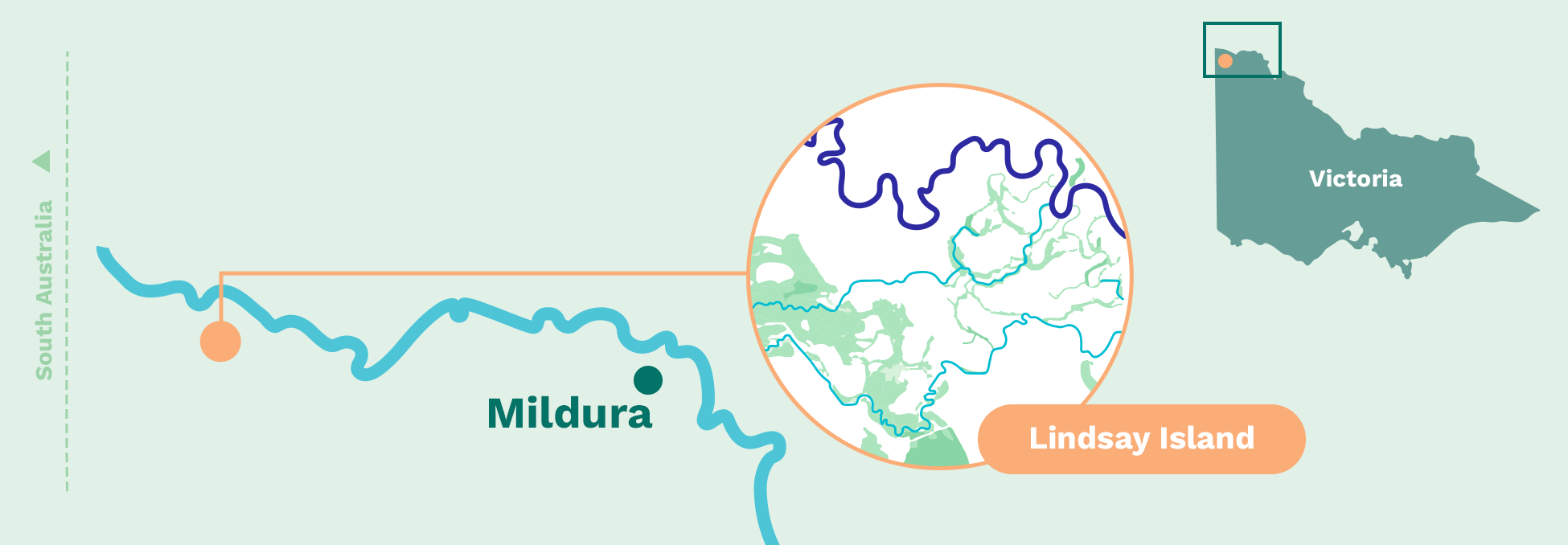
Lindsay Island is one of the Murray River's largest and most ecologically significant floodplain systems.
Location
North-west Victoria, approximately 75 km west of Mildura, near the New South Wales and South Australian borders.
Part of the Chowilla–Lindsay–Wallpolla floodplain within Murray-Sunset National Park.
 View on Google Maps
Information
Lindsay Island is the largest of the VMFRP sites and forms part of the significant Chowilla Floodplain icon site.
The Murray River and its floodplains evolved to flood regularly, supporting forests, wetlands and wildlife. Over time, river regulation, including dams, weirs and levees, has reduced the frequency, duration and extent of natural flooding. At Lindsay Island, some parts of the floodplain now go more than a decade between floods, which is too long for many plants and animals to survive.
The Lindsay Island Floodplain Restoration Project aims to restore more natural flooding patterns by improving how water moves onto, across and off the floodplain. Carefully designed infrastructure, used alongside environmental water, will allow water to be delivered when natural floods do not occur, and held on the floodplain for long enough to support ecological health.
Restoring flooding at Lindsay Island will help regenerate river red gum forests, black box woodlands, lignum shrublands and wetlands. It will also improve habitat for native fish, frogs, waterbirds, reptiles and mammals, and protect cultural heritage values that depend on stable soils and healthy landscapes.
Lindsay Island is a place of deep cultural, spiritual and historical significance for Traditional Owners. Protecting cultural heritage and working closely with Traditional Owners is a key consideration in planning the project.
The project is currently in the planning and approvals phase.
Project phase: Planning and environmental assessment
Fast facts
Up to 5,365 hectares
Of floodplain across Victoria and NSW targeted for improved ecological health.
Largest VMFRP site
Largest of the VMFRP floodplain restoration sites.
National importance
Part of a nationally important wetland system.
Threatened species
Supports threatened plants and animals, including fish, frogs, reptiles and waterbirds.
Living Murray legacy
Builds on earlier environmental works delivered under The Living Murray program.
Efficient water use
Securing environmental outcomes using less water, more efficiently.
Project milestones
Coming soon.
Why floodplain restoration is needed
Floodplains rely on regular wet and dry cycles to stay healthy. These cycles bring nutrients, support vegetation growth, and create breeding and feeding habitat for wildlife.
At Lindsay Island, reduced flooding has led to declining vegetation condition, stressed trees and loss of habitat. Some higher floodplain areas, including black box woodlands and lignum shrublands, are now rarely flooded, even during large river events.
By restoring flooding patterns, the project will help the floodplain recover, become more resilient to drought and climate change, and continue to support cultural, environmental and recreational values into the future.
Learn more: Lindsay Island flooding frequency fact sheet (PDF)
What is being planned?
The project proposes new and upgraded floodplain infrastructure that will work with natural river flows and environmental water to improve inundation across the floodplain.
Planned elements include:
- Regulators and containment banks to manage water movement
- A major regulator and fishway on the Lindsay River
- Temporary pump locations for use during dry periods
- Upgrades to existing access tracks where needed
Where possible, infrastructure will be located on previously disturbed areas, such as existing tracks, to minimise impacts on undisturbed landscapes.
News and media
Coming soon.
Frequently asked questions
Why is Lindsay Island being restored?
Flooding now occurs far less often than it once did, placing stress on floodplain plants and animals. Restoration will help return more natural flood patterns and improve long-term ecological health.
Lindsay Island supports a diverse range of flood-dependent ecosystems, including wetlands, forests and woodlands. These habitats provide food, shelter and breeding areas for native fish, frogs, reptiles, mammals and more than 200 bird species.
The area is an important cultural landscape. Thousands of years of Aboriginal history are reflected in culturally significant places across the floodplain. Floodplain restoration helps stabilise soils and reduce erosion, supporting the protection of these values.
2
Without action, vegetation condition and habitat quality are expected to continue declining, increasing risks to biodiversity, cultural heritage and floodplain resilience.
Will the project affect access to Lindsay Island?
During planning, there are no changes to access. Future watering events may temporarily affect some tracks, particularly during large natural floods. Any changes will be communicated in advance where possible.
How does Lindsay Island fit with other VMFRP sites?
Lindsay Island is one part of a coordinated program across northern Victoria. Together, the sites help improve river and floodplain health at a landscape scale.
Each site responds to local conditions, but all share a common goal: restoring more natural flooding patterns, improving ecological resilience, and achieving environmental outcomes using water more efficiently.
By delivering coordinated benefits across multiple floodplains, the program helps support healthier rivers, wetlands and communities along the Murray.
How is Cultural Heritage being managed?
A Cultural Heritage Management Plan is being prepared for the Lindsay Island site in consultation with Traditional Owners. The plan assesses the potential impact on Aboriginal cultural heritage and outlines ways to protect cultural heritage before, during and after construction. These plans are required under the Aboriginal Heritage Act 2006 (Vic.).
Traditional Owners have cultural, spiritual and economic connections to land, water and resources through their relationship with Country, built over tens of thousands of years. Working with Traditional Owners is central to protecting cultural values and informing how the project is planned and delivered.
How will water be delivered?
Water will be delivered using a combination of:
- Natural high river flows
- Managed flows using regulators
- Temporary pumping during dry conditions
Different watering approaches will be used depending on river levels and floodplain condition. In some years, water may flow naturally onto the floodplain. In others, infrastructure will allow water to be held for longer or delivered to areas that would otherwise remain dry.
This flexible approach allows the project to respond to changing conditions while using water efficiently.
What Environmental assessment and consultation has occurred?
The proposed works at Lindsay Island are being assessed through an Environment Effects Statement (EES) process. This process examines potential environmental, cultural, social and economic impacts and identifies measures to avoid or minimise effects.
Community and stakeholder engagement is an important part of planning. Feedback received during consultation helps inform project design and decision-making.
How will success be measured?
Monitoring programs will track vegetation condition, water quality and wildlife response over time to understand how the floodplain is recovering.
Who is delivering the project?
The VMFRP is delivered under the Murray–Darling Basin Plan by Lower Murray Water, in partnership with Goulburn-Murray Water, Mallee and North Central Catchment Management Authorities, Parks Victoria and the Department of Environment, Land, Water and Planning, through funding from the Australian Government's Department of Climate Change, Energy, the Environment and Water.
Learn more:
Sign up to receive updates
If you would like to receive email updates relating to the Lindsay Island project site, please register here:
Contact the project team
If you have questions about the Lindsay Island project site, or would like to provide feedback, please email the project team: info@vmfrp.vic.gov.au and we'll put you in touch with the right person.