Gunbower National Park project site
Gunbower National Park is one of Victoria's most significant river red gum floodplain landscapes, supporting internationally important wetlands, forests and wildlife.
Project information
I want to…
Location
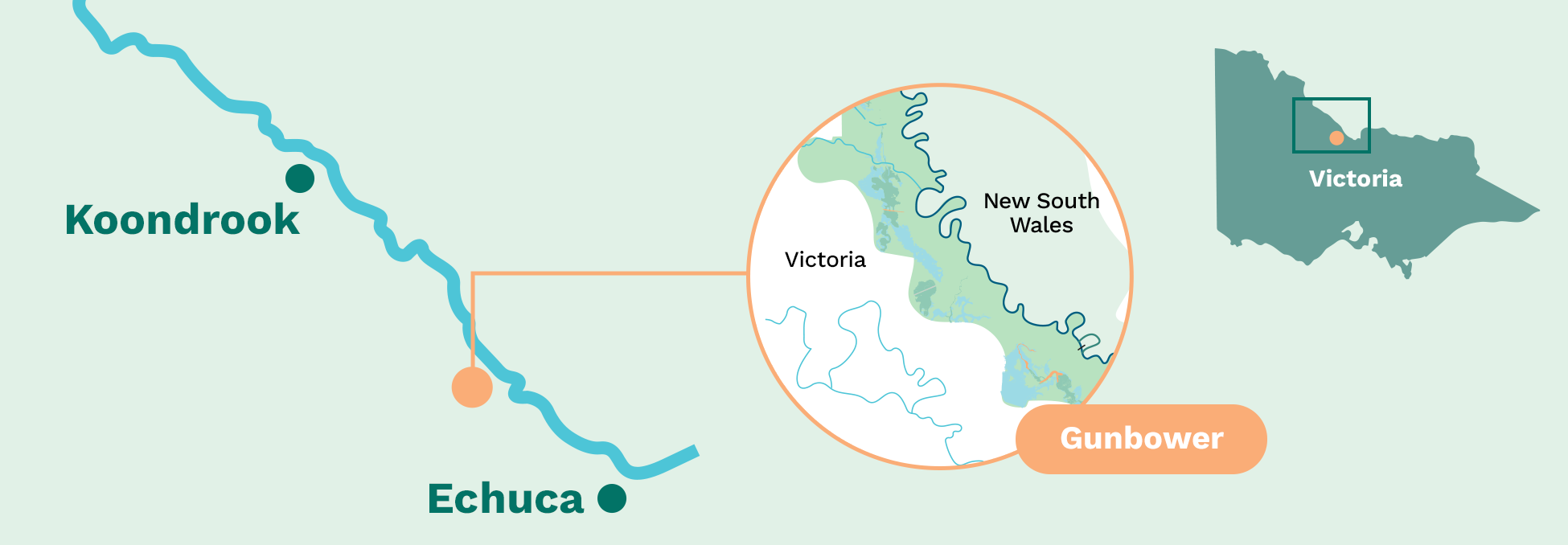
Northern Victoria, along the Murray River between Torrumbarry and Koondrook, near the towns of Cohuna and Gunbower. Part of the internationally significant Gunbower Forest and Murray River floodplain.
 View on Google Maps
Information
Gunbower National Park is one of the priority floodplain sites being restored under the Victorian Murray Floodplain Restoration Project (VMFRP). The site forms part of the internationally recognised Gunbower Forest, which is listed under the Ramsar Convention and in the Directory of Important Wetlands in Australia.
The Murray River and its floodplains evolved to flood regularly, supporting water dependant river red gum forests, wetlands and a wide range of native plants and animals. Over time, river regulation, such as dams, weirs, levees and irrigation infrastructure, has reduced the frequency, duration and extent of natural flooding across the floodplain.
At Gunbower National Park, some wetlands and forest areas now experience flows far less often than they need to stay healthy. In other areas, water has been delivered too frequently or at the wrong time of year, leading to stressed trees, changes in understorey vegetation and reduced habitat quality for wildlife.
The Gunbower National Park Floodplain Restoration Project aims to restore more natural flow patterns by improving how water for the environment can be delivered to, moved across, and retained on the floodplain. Carefully designed infrastructure, used alongside natural river flows and water for the environment, will allow for the gaps between what was and what should be to be plugged.
Restoring flows onto Gunbower National Park will help improve the condition of river red gum forests, wetlands and floodplain habitats. The project will support native fish, frogs, turtles, waterbirds, reptiles and mammals, and strengthen the ecological resilience of the forest to drought and climate change.
Gunbower National Park is a place of deep cultural, spiritual and historical significance for First Nations people, including the Yorta Yorta Nation Aboriginal Corporation and the Barapa Barapa. Protecting cultural heritage and working closely with First Nations people is a key consideration in planning and delivering the project.
The project is currently in the planning and environmental assessment phase.
Project phase: Planning and environmental assessment
Fast facts
About 550 hectares of floodplain targeted for improved ecological health across Gunbower National Park
Part of the internationally significant Gunbower Forest Ramsar site
Supports rare and threatened plants and animals, including native fish, frogs, turtles and waterbirds
Uses infrastructure and environmental water to achieve ecological outcomes using less water than river flood events
Keeps water in the region while improving floodplain health
Builds on decades of environmental management and community involvement
Project milestones
Coming soon.
Why floodplain restoration is needed at Gunbower National Park
Floodplains rely on regular wet and dry cycles to remain healthy. These cycles bring nutrients, support vegetation growth, trigger breeding events and create feeding habitat for wildlife.
At Gunbower National Park, river regulation and landscape changes have reduced natural flows and altered water movement across the floodplain. Some wetlands now receive water too infrequently, while others have experienced prolonged or poorly timed inundation, leading to declining vegetation condition and habitat loss.
By restoring more natural and efficient flow patterns, the project will help the forest recover, improve resilience to drought and climate change, and continue to support cultural, environmental and recreational values into the future.
What is being planned?
The project proposes new and upgraded floodplain infrastructure that will work with high river flows and environmental water to improve inundation across parts of Gunbower National Park.
Planned elements include:
- Gated structures (regulators) and containment banks to manage water movement and retain water on the floodplain
- Pump stations and pipelines to deliver water when river levels are too low to cause floodplain inundation
- A fishway to maintain connectivity for native fish
- Channels, pipes and structures to distribute water to wetlands and floodplain areas
- Upgrades to existing access tracks where required
Where possible, infrastructure will be located on previously disturbed areas, such as existing tracks and channels, to minimise impacts on undisturbed landscapes and cultural heritage.
News and media
Coming soon.
Frequently asked questions
Why is Gunbower National Park being restored?
Forest flows now occur less often, or at the wrong times, across parts of the floodplain, placing stress on wetlands, forests and wildlife. Restoration will help return more natural flow patterns and improve long-term ecological health.
Gunbower National Park supports a wide range of flood-dependent ecosystems that provide habitat for native fish, frogs, turtles, mammals and many waterbird species. The park is also part of an internationally significant wetland system.
The area is an important cultural landscape for First Nations people. Floodplain restoration helps stabilise soils, restore vegetation and support the protection of cultural heritage values.
2
Without action, vegetation condition and habitat quality are expected to continue declining, increasing risks to biodiversity, cultural heritage and the long-term resilience of the floodplain.
Will the project affect access to Gunbower National Park?
During planning, there are no changes to access. During construction and future watering events, some tracks or areas may be temporarily affected. Any changes will be communicated in advance where possible.
How does Gunbower National Park fit with other VMFRP sites?
Gunbower National Park is one of the floodplain sites being restored under the Victorian Murray Floodplain Restoration Project. Together, these sites aim to improve the health of the Murray River floodplain at a landscape scale.
Each site responds to local conditions, but all share a common goal: restoring more natural flooding patterns, improving ecological resilience, and achieving environmental outcomes using water more efficiently.
By delivering coordinated benefits across multiple floodplains, the program helps support healthier rivers, wetlands and communities along the Murray River.
How is Cultural Heritage being managed?
A Cultural Heritage Management Plan is being prepared as part of the project's environmental assessment process, in consultation with First Nations people. The plan assesses the potential impact on Aboriginal cultural heritage and outlines ways to protect cultural heritage before, during and after construction. These plans are required under the Aboriginal Heritage Act 2006 (Vic.) because these floodplains are areas of Aboriginal cultural heritage sensitivity.
Traditional Owners have cultural, spiritual and economic connections to land, water and resources through their relationship with Country, built over tens of thousands of years. Working closely with Traditional Owners is central to protecting cultural values and informing how the project is planned and delivered.
How will water be delivered?
Water will be delivered using a combination of:
- High flows in the river that pushes water into flood runners and creeks or over river banks and onto floodplains
- Managed flows using gated structures (regulators)
- Pumping environmental water during dry periods
Different approaches will be used depending on river conditions and floodplain needs. This flexible approach allows water to be used efficiently while supporting ecological outcomes.
Water delivered for the environment is relatively shallow (5 to 15 cm in depth) and will be targeted to the water dependant parts of the floodplain such as flood runners and low lying areas, not a deep flood across the whole forest floor like what happens in a flood event.
What Environmental assessment and consultation has occurred?
The proposed works are being assessed through a state and Commonwealth environmental assessment process. This examines potential environmental, cultural, social and economic impacts and identifies measures to avoid or minimise effects.
Community and stakeholder engagement is an important part of planning, and feedback helps inform project design and decision-making.
Will the project use more irrigation water?
No. The project uses existing environmental water entitlements and does not require further water buybacks. The approach helps keep more irrigation and consumptive water in the region while achieving environmental outcomes.
How will success be measured?
Monitoring programs will track vegetation condition, water quality and wildlife response over time to understand how the floodplain is recovering and whether ecological objectives are being met.
Who is delivering the project?
The VMFRP is delivered under the Murray–Darling Basin Plan by Lower Murray Water, Goulburn-Murray Water, Mallee and North Central Catchment Management Authorities, Parks Victoria and the Department of Environment, Land, Water and Planning, through funding from the Australian Government's Department of Climate Change, Energy, the Environment and Water.
Sign up to receive updates
If you would like to receive email updates relating to the Gunbower National Park project site, please register here:
Contact the project team
If you have questions about the Gunbower National Park project site, or would like to provide feedback, please email the project team: info@vmfrp.vic.gov.au and we'll put you in touch with the right person.